Access and safety: ladders, roof spaces and writing the limit as a judgement
The surveyor's own body is the instrument most at risk on site. Here is what the standards require, where it goes wrong, the kit worth carrying, and how to record where you did not go without writing a disclaimer.
- Chapter
- 01 — What you carry
- Entry
- 01.07
- Updated
- 12 October 2026
- Reading time
- 7 min
- Sections
- 06
- Status
- Published · checked at date shown
 On site · 01
Access is where the Home Survey Standard meets the Work at Height Regulations 2005, and the one part of the job where the instrument at risk is the surveyor. It is also a quiet source of complaints: the report says “roof space not accessible”, the buyer’s builder finds wet rot in the valley six months later, and the question becomes why the surveyor did not go up. Often the honest answer is that it was not safe, and the report should have said so, specifically. The kit here extends safe reach; the wording at the end makes the limit defensible when reach runs out.
What the standards require
RICS Surveying safely (2nd edition, November 2018) is a professional standard, not guidance. It expects the firm to have a safe system of work and the individual to assess risk on arrival and keep assessing it. The Home Survey Standard (2019, effective 1 March 2021) sets the scope at each level:
- Level 1: the roof space is inspected head-and-shoulders from the access hatch.
- Level 2: enters the roof space and inspects where safe and reasonable, without moving stored goods or lifting insulation beyond what is light and safe.
- Level 3: goes further where safe, including lifting insulation locally.
Ladders are used only where safe and reasonable, to no more than 3 m above floor or ground level. A flat roof within 3 m is looked at from a ladder at the eaves; anything higher is inspected from vantage points, a pole camera or a drone. At every level, record where you did not go and why.
The Work at Height Regulations 2005 set the order: avoid work at height where you can; where you cannot, use suitable equipment. HSE INDG455 (2014, revised 2021) says what suitable means for a ladder.
Three things distort the judgement on the day: the next appointment, the vendor at the foot of the loft ladder, and the fee. None appears in the standard.
Where it goes wrong
The ladder. Since 2018 EN 131 splits ladders into Professional and Non-professional, and Non-professional is not for work. Telescopic ladders must meet EN 131-6, and an unbranded one may not. The common faults: the wrong angle, an unfooted ladder on a wet patio, the top three rungs used to reach a gutter, and a ladder last inspected when it was bought.
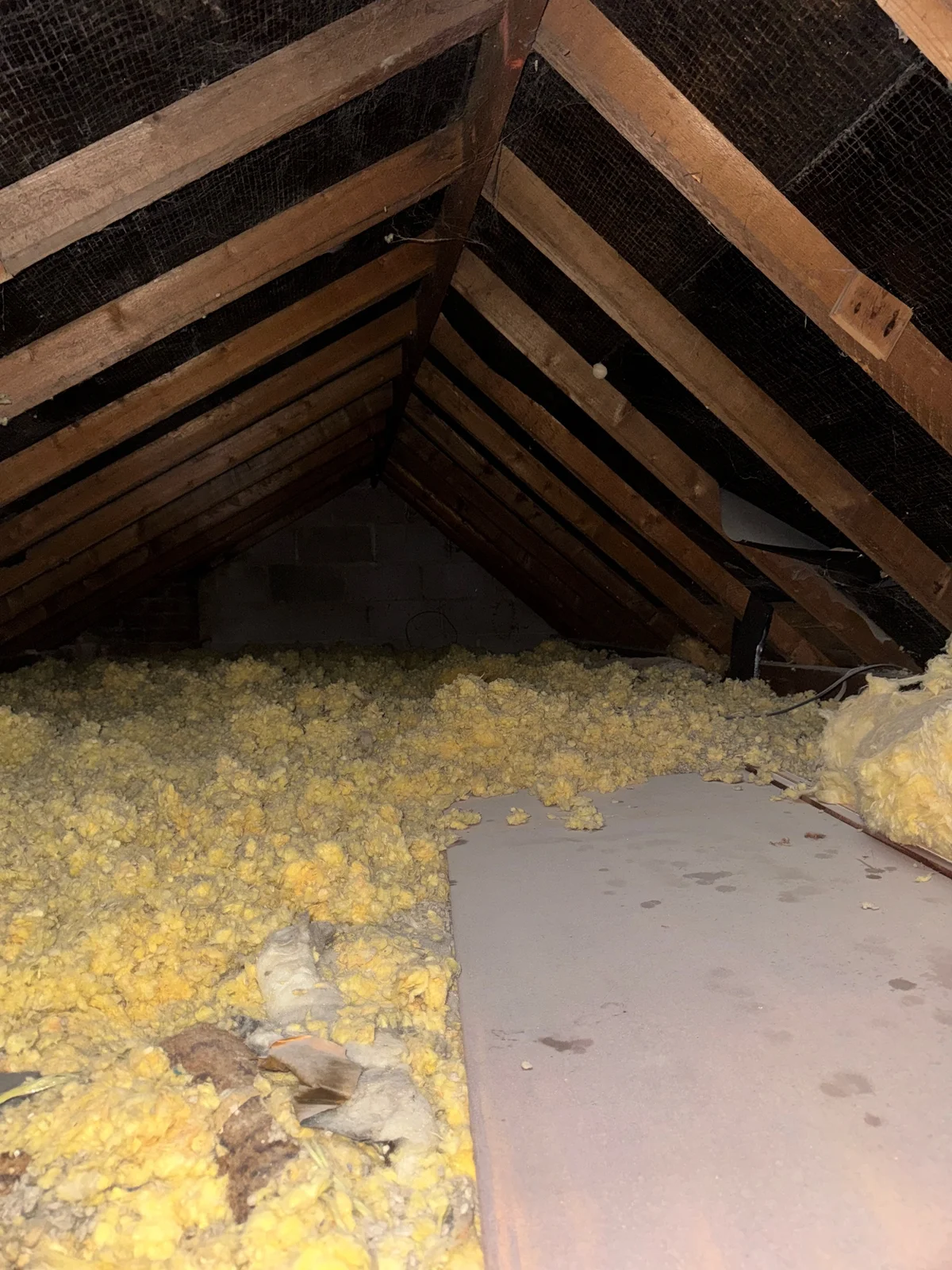
The roof space. The ceiling is not a floor: insulation hides the joists and a foot between them goes through plasterboard. Cold-water tanks are heavy and the boarding around them is not always sound. Live cables run across joists. Wasps nest in the eaves. Bats are protected under the Wildlife and Countryside Act 1981 and the Conservation of Habitats and Species Regulations 2017: do not disturb; note and report. Suspected asbestos in a pre-2000 building is left alone, noted and reported. Bird and rodent droppings carry Weil’s disease and histoplasmosis, which is why the mask is FFP3.
Drains. Fingers in the slot is how fingers are lost. Use keys and a lifter, and lift only a cover that is safe to lift. A chamber is a confined space; nobody enters one on a home survey.
Electrics and gas. Visual only, never tested. The consumer-unit cover stays on.
Lone working. Most residential surveying is done alone. An aggressive dog, a hostile occupier or a property plainly unsafe on arrival are reasons to stop. Stop, and say so in the report.
Drones. A sub-250 g drone, such as the DJI Mini 4 Pro, still needs a CAA Flyer ID and Operator ID, and the pilot must follow the Drone Code and check airspace restrictions. For a two-storey house a pole camera is usually simpler.
Using it so the result holds
Before leaving: tell someone where you are going and when you will check in; charge the phone; check the ladder register.
On arrival, a dynamic risk assessment: a minute of looking before touching anything. Dog, occupier, weather, overhead cables, the state of the paths. If it is wrong, do not start.
At the ladder: inspect it before every use; set it at 75°, 1 in 4; footed or tied; three points of contact; never the top three rungs; a stand-off at the gutter; 1 m above the landing point if stepping off; nothing above 3 m.
At the roof hatch: head-and-shoulders first, every time, with the headtorch on. Measure the hatch. Find the joists, the tank, the cables and the droppings before committing weight. Bump cap or hard hat, FFP3, gloves, knee pads. Walk on joists or a crawl board, never on the ceiling. Do not move stored goods. Lift insulation only where light and safe at Level 2, locally at Level 3.
At the drains: keys and a lifter; lift only if safe; look, photograph, replace.
Scope stays visual and non-invasive; opening up, drilling or testing is an agreed additional instruction with the owner’s written consent.
Photograph every point where you stopped: the hatch from below, the boarded roof space, the locked outbuilding. The limitation photograph is the one most often needed later.
What to buy
UK prices inc VAT, October 2026; prices move, so check the live price.
| Model | What it is | Indicative UK price (inc VAT, Oct 2026) | Verdict |
|---|---|---|---|
| Telesteps, Lyte or Werner telescopic ladder, EN 131-6 Professional | 3.8 m telescopic, certified for work | About £150–£300 | Buy a known brand and keep a register. |
| Ladder stand-off | Bracket that holds the ladder off the gutter | Check live price | Buy it with the ladder. |
| Petzl Actik Core headtorch | 400+ lumens, rechargeable | About £60 | The default. The Ledlenser MH series is the alternative. |
| Bump cap or hard hat | Head protection in the roof space | Check live price | A bump cap is enough for most roof spaces. |
| FFP3 disposable masks | Filters insulation fibres and dried droppings | Check live price | FFP3, not FFP2. Carry a box. |
| Gloves and knee pads | For joists, tanks and droppings | Check live price | Used every visit. |
| Crawl board | A board to span joists | Check live price | Only useful if it fits through the hatch. |
| Drain keys and cover lifter | For lifting inspection chamber covers | Check live price | Essential. |
| Pole camera | Camera on a telescopic pole for roofs above 3 m | Check live price | Usually the answer for a two-storey roof. |
| DJI Mini 4 Pro or similar sub-250 g drone | Camera drone for roofs beyond pole reach | Check live price | Only with Flyer ID, Operator ID and practice. |
The purchase that matters is the ladder: it is the item that can hurt you and the one the regulations are written about. A 3.8 m EN 131-6 Professional telescopic from Telesteps, Lyte or Werner at about £150–£300 covers the 3 m limit, fits in an estate car and is inspected in thirty seconds. The headtorch is second; 400 lumens is the floor, because a roof space lit by phone flash is one you did not really see.
The extra money buys reach above 3 m, and the pole camera is the better first step: no licence, works in wind that grounds a drone, a minute to deploy.
Not worth paying for: a drone for the occasional roof. The IDs, airspace checks and practice make it a commitment; if roofs above pole reach are rare in your work, say so in the report and recommend a roofer’s inspection.
Recording it in the report
The Home Survey Standard requires the extent of the inspection and its limitations to be stated specifically. A limitation is a professional judgement with a reason, written as one. Keep the elements separate: what was limited, why, what could not be assessed as a result, what the client should do about it, and whether it changes a condition rating.
Weak: “Roof space not accessible.”
Wording that holds: “The roof space was inspected from the access hatch only, because the hatch opening measured about 350 mm square and safe entry was not possible. Roof timbers, insulation and the underside of the covering were seen for about 2 m around the hatch and not beyond. We recommend the hatch is enlarged and the full roof space inspected before exchange. The condition rating for the roof structure is given on the basis of this partial inspection.”
Add the time, the weather and who was present. If a dog, an occupier or the state of the property stopped you, say so in the same plain register.
References
- RICS, Surveying safely: health and safety principles for property professionals, 2nd edition, RICS, November 2018
- RICS, Home Survey Standard, RICS, 2019 (effective 1 March 2021)
- RICS, Home survey health and safety checklist, RICS
- HSE, INDG455 Safe use of ladders and stepladders, HSE, 2014 (revised 2021)
- Work at Height Regulations 2005, SI 2005/735
- Wildlife and Countryside Act 1981
- Conservation of Habitats and Species Regulations 2017
Where to buy
Suppliers
Manufacturer or primary UK stockist. Check the live price and the current specification before buying.
- 01RICS – Surveying safely: health and safety principles for property professionals, 2nd edition ↗The professional standard that governs how a surveyor approaches risk on site. Published November 2018. Free to download.
- 02RICS – Home survey health and safety checklist ↗The pre-inspection and on-site checklist that sits alongside the Home Survey Standard. Free.
- 03HSE – INDG455 Safe use of ladders and stepladders ↗The ladder guidance a ladder register should be built on. 2014, revised 2021. Free to download.